It is a Tuesday in late November, twenty to five, and already dark outside. A deputy head walks along the corridor and sees one classroom light still on. Inside, a teacher sits behind a stack of exercise books, a cup of tea long gone cold beside them.
“All right?” she asks.
“Fine, thanks. Just busy.”
Both of them smile. Both of them know it is not quite the whole answer.
This is a composite scene, not a real person, but you will probably recognise it.
If you lead a school, you have probably been on both sides of that conversation this term. This article is about what sits behind “fine, just busy”, and some small, kind ways to find out.
Why late November feels heavier
The autumn term is the longest of the year. By now the novelty of September has worn off, the evenings are dark, and the calendar is full: assessments, reports, parents’ evenings, performances and the run-up to December.
None of this means anyone is doing anything wrong. It is simply a demanding time, felt differently by different people. An early career teacher may be quietly wondering whether everyone else finds it this hard. A teaching assistant may be absorbing a great deal of emotion from the pupils they support. A headteacher may be holding everyone else’s worries and saying very little about their own.
Pupils feel the stretch of the term too, and so do parents, who are juggling work, money and family life as Christmas approaches.
Which of those groups do you feel you have the clearest picture of right now? And which the least?
What the national picture tells us
The Department for Education’s Working lives of teachers and leaders survey asks more than 10,000 teachers and leaders in English state schools about their work each year. The wave 4 summary report, based on fieldwork in spring 2025, has some genuinely encouraging news. All of its measures of overall wellbeing improved compared with previous waves, and 26% of teachers and leaders agreed their workload was acceptable, up from 22% in 2024 and 17% in 2022 and 2023.
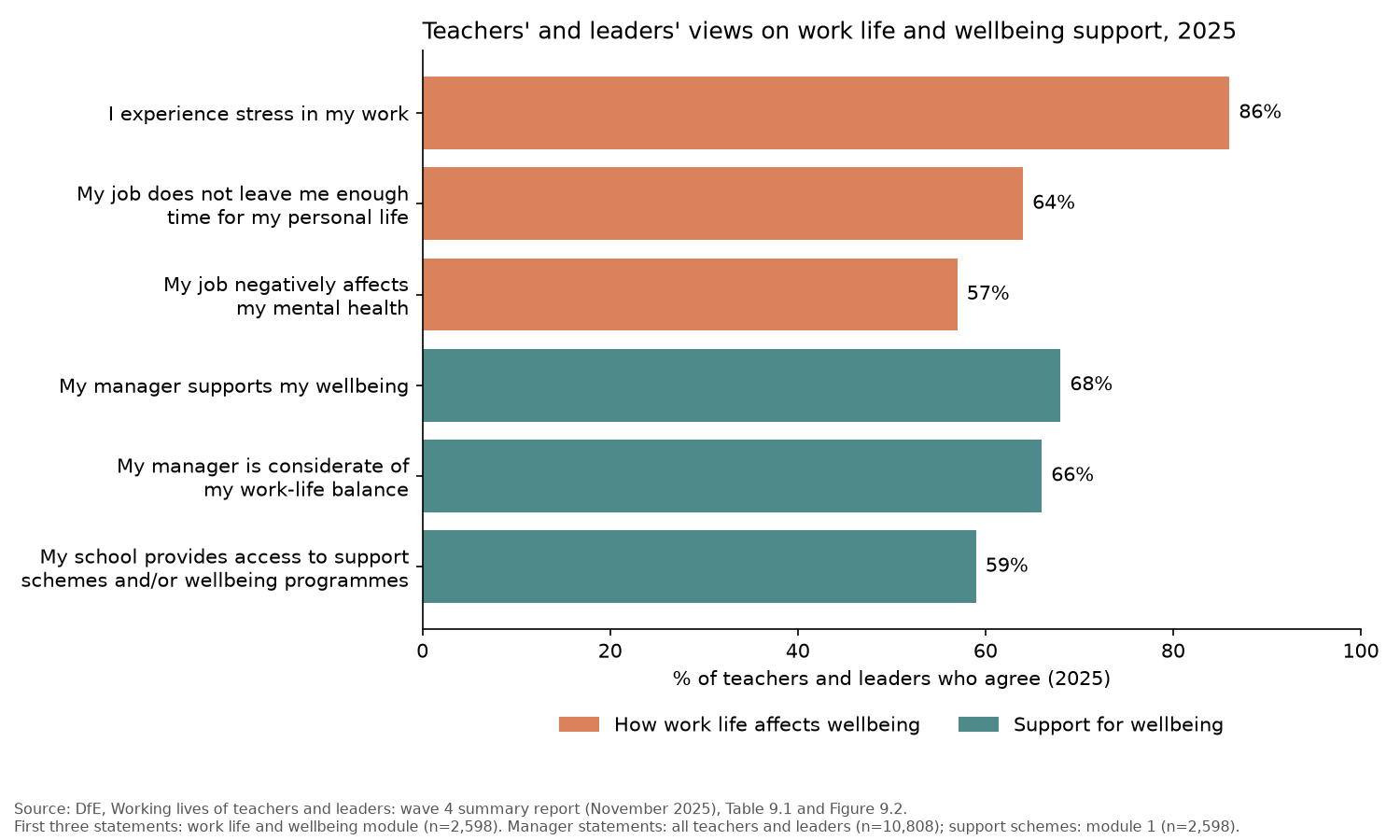
The same report is also a reminder of how much people are carrying. In the work life and wellbeing module, 86% agreed “I experience stress in my work” and 57% agreed their job negatively affects their mental health.
There is something hopeful here as well: 68% of teachers and leaders agreed that their manager supports their wellbeing. What leaders do day to day clearly matters.
“Fine, just busy”: why the corridor question is not enough
Most staff will not tell a busy leader in a corridor that they are struggling. They do not want to be a burden, they are not sure it is the right moment, or they simply have not had time to notice how tired they are.
That is not a failing on anyone’s part. But it does mean a warm “all right?” in passing, valuable as it is, cannot give you the full picture.
The DfE’s Education staff wellbeing charter recognises this. Among its organisational commitments, it asks schools to give staff a voice in decision-making and to “measure the wellbeing of staff using recognised tools and metrics and be transparent about results”, monitoring trends over time and acting on changes.
“Our staff are a precious resource: valuing them, and their wellbeing and mental health, is a duty we all share.”
The Education Staff Wellbeing Charter, DfE
The same applies to pupils: the guidance Promoting children and young people’s mental health and wellbeing sets out eight principles of a whole school or college approach.
Small things you can do this week
No new initiative is needed before the end of term. Try one or two of these:
- Ask a better question. Swap “all right?” for “What is one thing that would make next week easier?” Then follow up on what you hear.
- Remove one task. Look at the next three weeks and find one meeting, deadline or piece of paperwork that can be dropped or moved. Tell staff you have done it.
- Be clear about evenings. The charter encourages clear guidance on when it is, and is not, reasonable to expect staff to reply to messages out of hours.
- Include everyone. The charter covers support and temporary staff too. Who in your school is easiest to overlook?
- Look after leaders. The charter asks for a specific approach to protecting leader wellbeing and mental health. Who checks in on you?
- Signpost support. Make sure everyone knows where to turn, including Education Support’s free 24-hour helpline for education staff, which the DfE charter page lists.

Listening regularly, not once a year
Listening little and often, rather than relying on a single annual survey, makes it easier to spot a change early and to show staff that what they say leads to action.
This is what mySchoolWellbeing was built for. Schools send short wellbeing checkpoints to staff, parents or pupils, either through a connection to the school’s MIS (UK only) or a shareable OnDemand link. You can use the library of ready-made questions or customise questions and schedules yourself. An easy-to-digest report arrives in your inbox, with a monthly Wellbeing Score © you can track over time, and the reports were designed with the Ofsted framework in mind. Multi-academy trusts can view staff wellbeing and parent voice reports from each of their schools.
If you would like to see what that looks like before the spring term, you can request a free sample report for staff wellbeing, parent voice or pupil voice. Details of plans are on our pricing page.
And tomorrow, when you pass that one lit classroom at twenty to five, perhaps knock, sit down for two minutes and ask the better question.
Key takeaways
- Late November is demanding for staff, pupils, parents and leaders alike; “fine, just busy” rarely tells the whole story.
- The DfE’s wave 4 Working lives of teachers and leaders survey shows wellbeing measures improving, yet 86% of teachers and leaders agreed they experience stress in their work.
- What managers do matters: 68% agreed their manager supports their wellbeing.
- The Education staff wellbeing charter encourages schools to give staff a voice and to measure wellbeing over time.
- This week: ask a better question, remove one task, be clear about evenings, include everyone and look after leaders.
Self-check quiz: how well do you know how your staff are feeling?
Score 2 for “Yes”, 1 for “Partly” and 0 for “Not yet”.
- Have you asked staff about their wellbeing in a structured way this term?
- Would you notice within a month if wellbeing in one team or phase began to dip?
- Do staff know when they are, and are not, expected to reply to messages out of hours?
- Are support and temporary staff included in how you listen to staff?
- Do you tell staff what you heard and what changed as a result?
8–10: Strong foundations.
You are listening well. The next step is making sure you can see trends over time.
4–7: Good intentions, some gaps.
Pick the question you scored lowest on and make it your focus for the spring term.
0–3: A real opportunity.
You are not alone, and small, regular check-ins are a manageable place to start.
Whatever your score, you can see what regular wellbeing reporting looks like by requesting a free sample report.
Sources
- Department for Education, Working lives of teachers and leaders: wave 4 (published 27 November 2025) – https://www.gov.uk/government/publications/working-lives-of-teachers-and-leaders-wave-4 (summary report PDF: https://assets.publishing.service.gov.uk/media/693bdc426a12691d48491e9b/Working_lives_of_teachers_and_leaders_wave_4_summary_report.pdf)
- Department for Education, Education staff wellbeing charter (last updated 8 May 2024) – https://www.gov.uk/guidance/education-staff-wellbeing-charter (charter PDF: https://assets.publishing.service.gov.uk/media/6194eb37d3bf7f0551f2d1a5/DfE_Education_Workforce_Welbeing_Charter_Nov21.pdf)
- Office for Health Improvement and Disparities and Department for Education, Promoting children and young people’s mental health and wellbeing (last updated 16 November 2023) – https://www.gov.uk/government/publications/promoting-children-and-young-peoples-emotional-health-and-wellbeing
- mySchoolWellbeing feature descriptions taken from https://myschoolwellbeing.com and https://myschoolwellbeing.com/free-sample-report/ (read 23 November 2026).
Published: 23rd November 2026
Back to blog